Overview
The Project Data Science Engineer (DSE) Program is an advanced learning path designed for technical professionals who configure, validate, and enhance Pricefx AI Optimization accelerators. This program builds the skills required to deploy, operate, and customize accelerators such as Negotiation Guidance, List Price Optimization, and Product Recommendations, using transparent, explainable “science bricks” within Pricefx’s clearbox AI framework.
Learners develop both the business understanding and technical depth needed to translate pricing strategies into data-driven AI models. The program combines self-study modules, hands-on labs, and instructor support to build confidence across the entire modeling lifecycle.
Good to Know
Access to training content, materials, and the practice environment is provided for a period of 1 month. Access is activated every Monday.
Public Q&A sessions take place every Wednesday. Attendance is optional but highly recommended, as these sessions focus on clarifying the training materials. They are not intended for discussing customer- or partner-specific configurations or project topics. If no participants join within the first 15 minutes, the Technical Training Advisor may cancel the session. To get the most value, we encourage students to submit their questions in advance.
Prerequisites
Participants should have:
-
Knowledge of pricing data structures (transactions, product/customer master, costs).
-
Familiarity with ML concepts (segmentation, clustering, elasticity, model evaluation).
-
Experience with data pipelines, integration workflows, and validating analytical outputs.
Key Characteristics
-
Delivered as a mix of self-paced modules, scenario-based labs, and Q&A sessions.
Effort estimation ~11 hours self-study (≈ 3 days) + public Q&A sessions
-
Designed for Data Science Engineers, Technical Consultants, and Solution Architects.
-
Learners receive a Certificate of Completion (no certification exam).
Content Alignment & Improvements
Training aligns directly to real Pricefx AI project phases and emphasizes:
-
Quickly achieving value with out-of-the-box accelerators.
-
Understanding each model stage and its business impact.
-
Troubleshooting model behavior with data and log insights.
-
Making targeted modifications through science bricks, parameters, and settings.
Learning Flow
1. Business Overview: PricingAI, Copilot, Agents & Science Bricks
Learners explore:
-
PricingAI and its role in price optimization
-
Copilot for conversational insights and guidance
-
Agents for multi-agent AI coordination
-
Clearbox AI for transparency and trust
-
Science bricks, the modular components that drive segmentation, clustering, elasticity, and similarity
This establishes a complete understanding of how Pricefx AI recommendations are generated.
2. Data Foundations
This module covers:
-
How data completeness, consistency, and clarity influence model outcomes
-
Common pitfalls such as inconsistent hierarchies, missing attributes, or biased samples
-
How to validate inputs and prepare for accelerator configuration
The emphasis is on understanding the practical impact of data quality on model reliability.
3. Target Accelerators in This Program
Learners work with three primary AI Optimization accelerators:
-
Negotiation Guidance – contextual deal guidance based on segmentation and driver analysis
-
List Price Optimization – market-facing list prices using clustering, elasticity (optional), and simulation
-
Product Recommendations – cross-sell and upsell suggestions using product similarity and customer patterns
4. Install & Verify
Participants practice:
-
Checking environment prerequisites
-
Installing accelerators with minimal required configuration
-
Running health checks to verify models, bindings, dashboards, and science bricks
-
Iterating with business users to validate early results
This builds confidence in deploying accelerators quickly and safely.
5. Modeling Basics
Learners configure full model pipelines, including:
-
Segmentation
-
Driver Importance
-
Elasticity (optional)
-
Simulation
-
Recommendations & Review
Hands-on exercises reinforce the impact of each modeling step and how to tune the accelerator for business relevance.
6. Model Classes & Logics
This module introduces:
-
How standard and customizable model classes work
-
Differences between standard logic and modified logic components
-
How to evaluate logic behavior and performance
-
Where model configurations can be safely adapted
7. Customizing Accelerators
Learners explore how to tailor accelerators by:
-
Understanding the underlying components and libraries
-
Modifying science bricks such as segmentation, clustering, elasticity, or similarity
-
Assessing how changes influence model behavior and recommendations
This module focuses on safe, targeted customization based on solution needs.
8. Deployment Approach
Participants learn:
-
How to run accelerators end-to-end early to expose data or configuration gaps
-
How to incorporate iterative feedback cycles with business stakeholders
-
How to scale from initial deployment to additional use cases
9. Business Impact
The program concludes with guidance for demonstrating and communicating impact, such as margin improvement, improved consistency, and faster decision-making enabled by clearbox AI.
Instructor Support & Q&A Sessions
-
Weekly Q&A sessions cover training-related questions.
-
Private deep-dive sessions may be purchased for customer-specific needs.
-
Hands-on labs allow learners to apply concepts directly in accelerator configurations.
Certificate of Completion
This program does not include a certification exam.
Learners receive a Certificate of Completion when all modules and labs are finished.
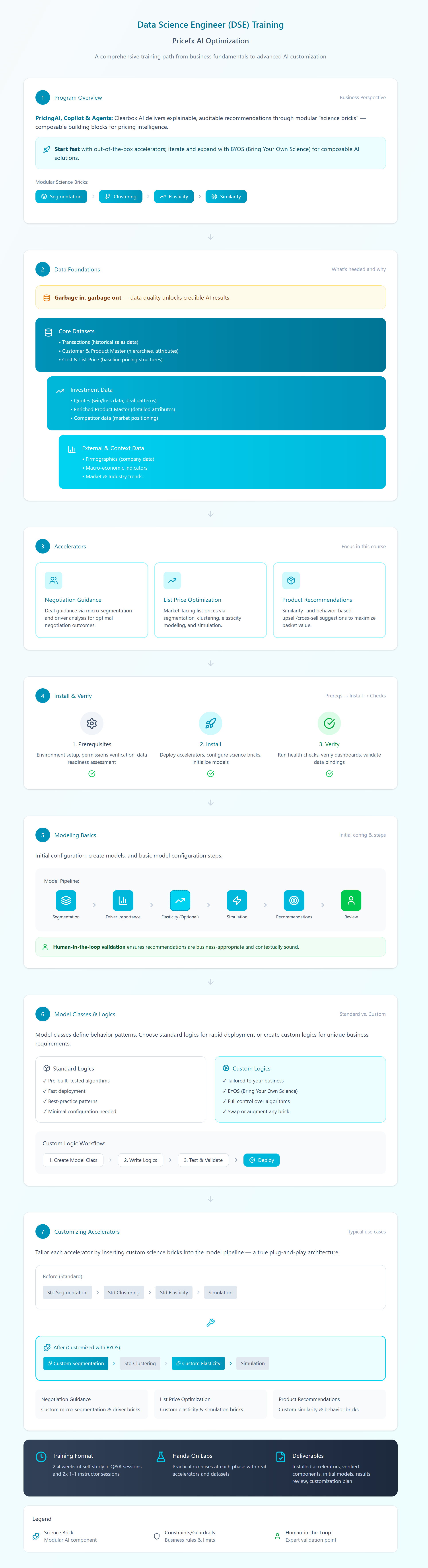
Training Structure
In the graphic below, you can see a visual representation of the new Project DSE Practitioner training format and its main components.