
Pricefx Agents capabilities depend on the data available, its level of detail, and how consistently products, customers, and commercial events are linked. Use the scenarios below to identify the appropriate setup.
Each scenario below explains the data condition (Data), why it matters (Why it Matters), and what to do about it (Advice).
|
Scenario |
Product Data |
Customer Data |
Transaction or Quote Data |
Trigger Condition |
Main Advice |
|---|---|---|---|---|---|
|
|
Line-item transactions with:
|
Products, Customers, and Transactions are all present with stable IDs. |
|
|
|
Standard product data plus cost, competition, stock, availability, or other commercial signals |
Standard customer data |
Standard transactions plus dated enrichment data |
Standard case data is enriched with cost, competitive pricing, inventory, or other signals. |
|
|
|
Product Ids and attributes where available |
Customer Ids and attributes where available |
Sparse or short-window transactions; quotes or datamart copies may supplement them |
Transaction data is sparse, scoped to a subset, or covers less than a year; Quotes may supplement it. |
|
|
|
Feature/option attributes or a configuration fingerprint; no stable product Id |
Customer Id where available |
Quote or transaction lines containing configuration features |
Products lack a persistent Id and are instead defined by feature combinations. |
|
|
|
Product Ids and attributes |
Customer Ids with incomplete hierarchy or segmentation; optional cluster Id and label |
Transactions linking products and customers |
Customer IDs exist, but hierarchy, segment, or geography attributes are incomplete. |
|
|
|
Product definitions by business unit |
Customer definitions by business unit |
Transactions with:
|
One instance spans divisions with different policies or data definitions, possibly in different currencies. |
|
|
|
Product Ids or configuration features where available. |
Customer Ids and attributes where available. |
Quotes with:
|
Only Quote data is available. No realized transactions or insufficient transaction history exist. |
|
Decision-flow Diagram
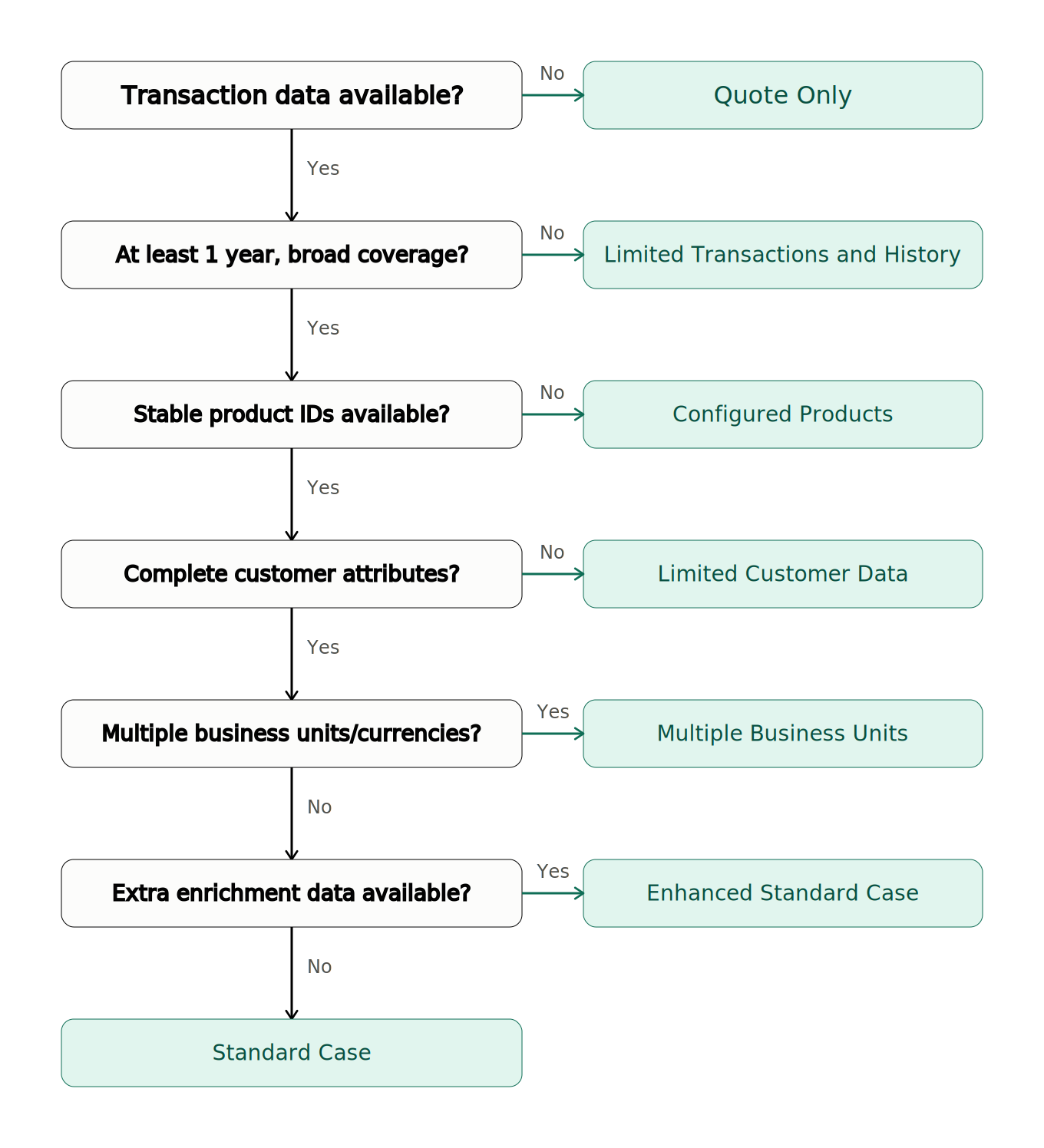
Real data situations often overlap. The tree picks the first matching condition top-to-bottom, so it is a reading aid, not a strict algorithm.