
Find all relevant Pricefx Training Offering information here.
Pricefx Customer Self-Sufficiency Guide
Self-sufficiency is Pricefx's enablement model that empowers your internal team to independently manage, maintain, and grow your Pricefx solution after go-live. It is a gradual process — it takes months, not weeks — and it requires a real investment of time and people on your side.
This guide covers two levels of self-sufficiency and what it takes to achieve each one.
Level 1: Maintenance Self-Sufficiency
What does it mean?
Maintenance self-sufficiency is the ability of your internal team to manage and maintain your existing Pricefx solutionday-to-day — without relying on Pricefx or your implementation partner for routine operations.
This includes tasks like:
-
Managing users, roles, and permissions
-
Troubleshooting common issues (e.g. why a price list was not recalculated)
-
Keeping the solution running smoothly after go-live
-
Staying current with new Pricefx releases and understanding how they affect your setup
Important: Maintenance self-sufficiency covers your current, already-implemented capabilities only. It does not mean building or designing new capabilities from scratch — that is Level 2.
How do you get there?
There are three steps to reach maintenance self-sufficiency:
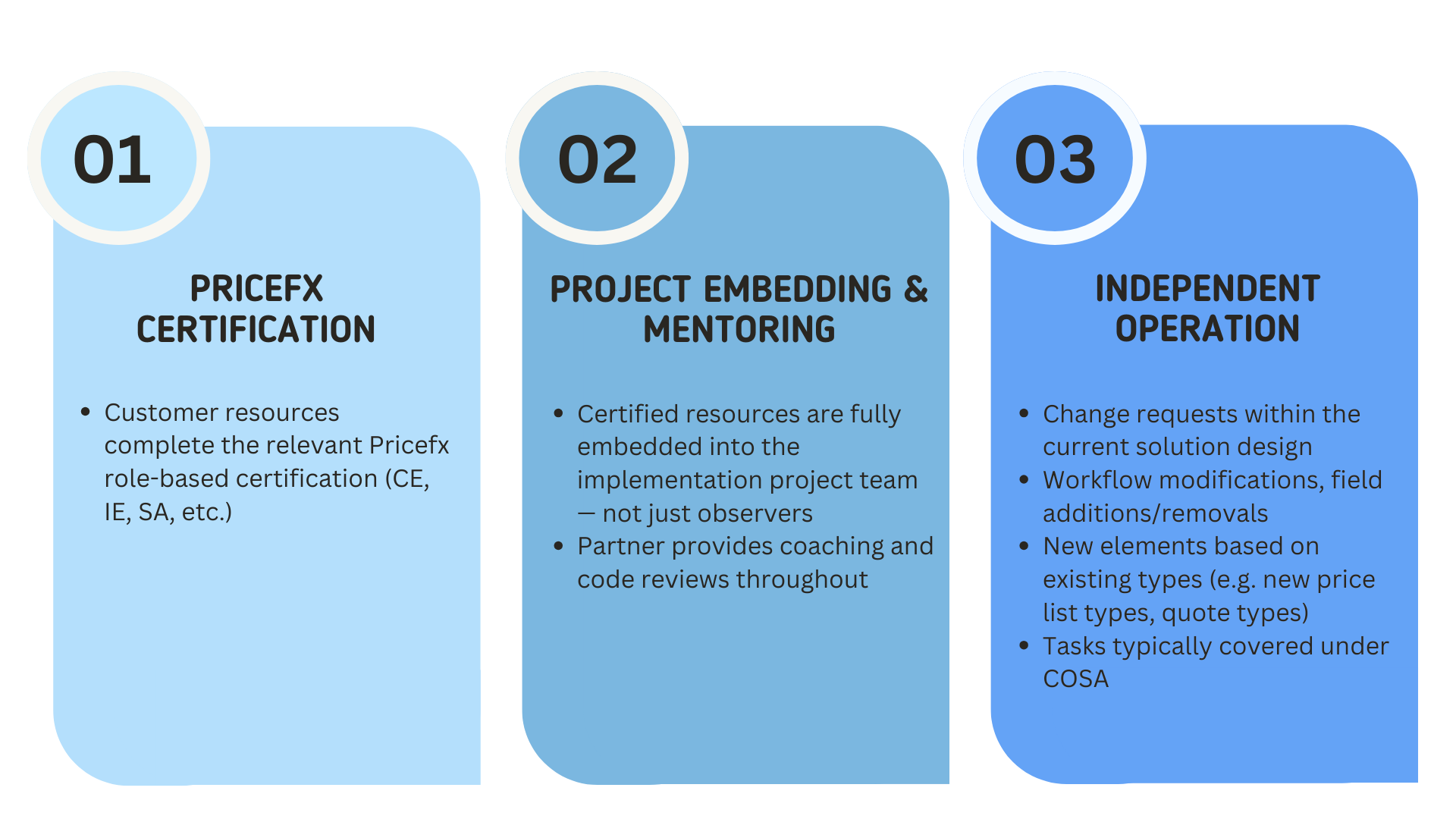
Step 1 — Get certified All technical resources nominated for self-sufficiency must complete Pricefx certification before anything else — no exceptions. Depending on their role, this includes:
-
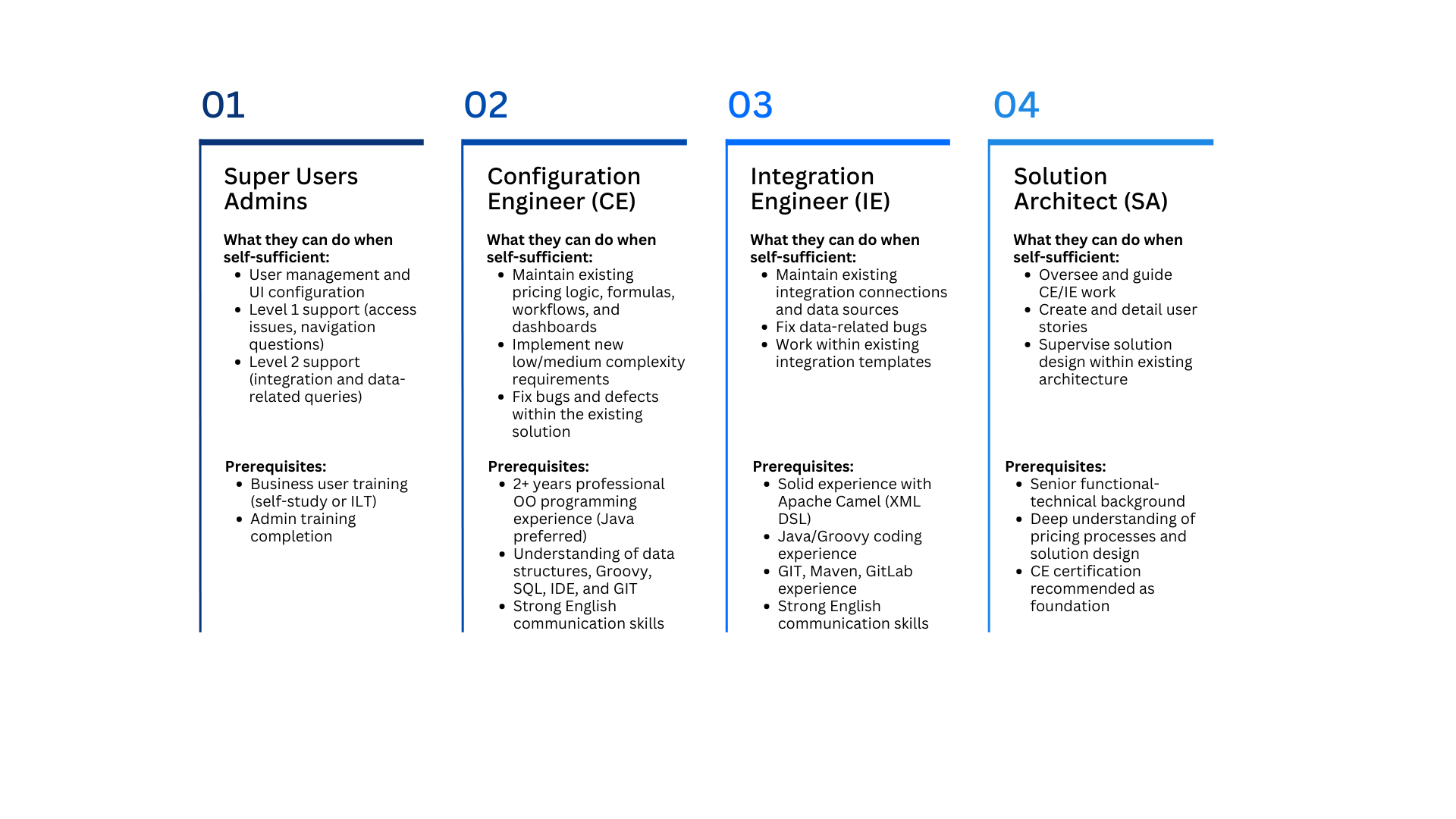
Configuration Engineer (CE) — maintains the existing solution, implements new simple/medium-level requirements, fixes bugs
-
Integration Engineer (IE) — maintains integrations and data connections
-
Solution Architect (SA) — optional for maintenance, but recommended; owns solution design and guides CE/IE work
Step 2 — Mentoring and shadowing Once certified, your resources should work alongside the implementation partner (or Pricefx, if no partner is involved) for 4–6 months. During this period, they gradually take over development tasks with decreasing supervision. This is mandatory and must be planned in advance with your partner.
Step 3 — Maintain independently After mentoring is complete, your team takes over. To stay self-sufficient, they should:
-
Stay up to date with new Pricefx releases and understand their implications
-
Use the Pricefx Knowledge Base and AI Copilot for day-to-day questions
-
Recertify as the platform evolves (recommended every 2 years)
What team do you need?
|
Role |
Requirement |
|---|---|
|
Configuration Engineer (CE) |
Minimum 1 — mandatory (per capability) |
|
Solution Architect (SA) |
Recommended, but optional for maintenance |
|
Integration Engineer (IE) |
If your solution includes integrations |
Things to keep in mind
-
Self-sufficiency is a gradual process — it takes real commitment from your team
-
Your implementation partner plays a critical role — they must agree to embed your resources into sprint delivery during the project
-
Support services (bug fixes, upgrades, new features) remain separate engagements — self-sufficiency does not replace them
-
Once your internal resources begin maintaining the solution, Pricefx is not liable for any outcomes resulting from their actions
Level 2: Building Capabilities
What does it mean?
Level 2 is about expanding your Pricefx solution by adding net-new capabilities — ones that were not part of your original implementation. Examples include adding Rebates, Negotiation Guidance, Analytics, or entirely new modules.
This level is only possible once Level 1 is solid. You should not attempt to build new capabilities before your team is comfortable with maintaining the existing solution.
Prerequisites — before you start
Before moving to Level 2, make sure the following are in place:
-
6 months in maintenance mode — your team is fully comfortable with the existing solution and handles day-to-day tasks independently
-
Staying current with releases — you have a process to track new Pricefx releases and understand their implications for your setup
-
Expert Services contract in place — you have agreed consultation hours with Pricefx or a Partner Solution Architect to support the build
How can you approach it?
There are two realistic paths:
✅ Recommended: Hire an SA with experience in the capability
The safest and most efficient route. An SA who has already worked with the specific capability you want to add (e.g. rebates, analytics) brings the design knowledge, reduces implementation risk, and guides your CE team through the build. This person can be hired as an in-house resource or through outsourcing/a partner.
This is the option we recommend. New capabilities — especially complex ones like Rebates or Analytics — have many technical pitfalls. Having someone who has done it before in Pricefx makes a significant difference in both speed and quality.
⚠️ Alternative: Build as you go
If you choose not to bring in external expertise, you can use your contracted consultation hours to guide your team through the build. Be aware that this path carries higher risk, a slower pace, and a steep learning curve. Your team will likely make more mistakes and the project will take longer. We do not recommend this path, but we understand it may be the right choice for some organizations.
What team do you need?
|
Role |
Requirement |
|---|---|
|
Configuration Engineer (CE) |
1 CE per new capability being built |
|
Solution Architect (SA) |
Mandatory for Level 2 — drives design and guides CE/IE work |
If you are bringing in a new capability and do not yet have an SA, Level 2 is the time to hire or onboard one.
💡 Best Practice: Train before you build
If your team has not yet worked with the new capability, we strongly recommend completing the relevant Pricefx business training before starting the build. It gives your team hands-on context and a solid foundation — and significantly reduces risk.
You can find available learning paths and programs in the Pricefx Knowledge Base.
⚠️ Commercial consideration — talk to your CSM first
Building new capabilities can have licensing, data volume, and hosting cost implications that are easy to overlook. For example:
-
Adding a capability you have not licensed may require a contract change
-
Increased data volumes or processing requirements can affect hosting costs
-
Some advanced capabilities (e.g. dynamic pricing engine) may require a premium SLA
Before you start building — contact your Customer Success Manager. Your decisions at this stage may have financial implications, and it is better to align early.
Summary: Self-Sufficiency at a Glance
|
|
Level 1: Maintenance |
Level 2: Building Capabilities |
|---|---|---|
|
Goal |
Manage and maintain your existing solution |
Add new capabilities not yet implemented |
|
Key prerequisite |
Certification + 6 months of mentoring |
Level 1 complete + 6 months in maintenance |
|
Minimum team |
1 CE (SA recommended) |
1 CE per capability + SA (mandatory) |
|
Pricefx/Partner role |
Mentoring and supervision |
Expert Services consultation hours |
|
Risk if skipped |
Solution instability, dependency on vendor |
High implementation risk, cost overruns |
Questions?
Reach out to your Customer Success Manager or visit the for more details on training programs, pricing, and next steps.
🧩 Recommended Roles and Profiles
Project Configuration Engineer (CE)
Purpose:
Maintains and extends Pricefx configurations — pricing logic, formulas, workflows, dashboards, and quoting setup.
Ideal Profile:
-
Professional coding experience of object-oriented programming language (i.e. Java)
-
Solution development, problem-solving, testing, and troubleshooting skills are required
-
Understand data structures (Arrays, Maps), algorithmizing and coding skills (variables, loops, conditions), and Groovy language features (syntax, operators, closures)
-
Experience with databases and data, ideally SQL, working with tables, and examine data
-
Working knowledge of IDE (IntelliJ Idea or other) and GIT (feature branches, checkout, pull, push, commit, rebase, amend, merge, stash)
-
Good spoken and written English, CEFR B2 level required. Must be able to communicate and confidently express thoughts and understand technical documentation and requirements.
.png?cb=9a35df6e383103d6b2f4858ba1d154bd)
Prerequisites:
-
Completion of Business User Program and Admin Program.
-
Basic understanding of data structures, pricing workflows, and formula logic.
-
English proficiency (training and certification are in English).
Project Integration Engineer (IE)
Purpose:
Manages and supports data integration between Pricefx and other enterprise systems (ERP, CRM, data warehouse).
Ideal Profile:
-
Professional coding experience of object-oriented programming, ideally Java, Groovy, or C++
-
Understand data structures (Arrays, Maps), algorithmizing and coding skills (variables, loops, conditions), and Groovy language features (syntax, operators, closures)
-
Working knowledge of IDE (IntelliJ Idea or other) and GIT (feature branches, checkout, pull, push, commit, rebase, amend, merge, stash)
-
Good understanding of the Apache Camel integration framework — specifically, the XML DSL variant
.png?cb=c5d1b207c444d7c21f6b6327807837eb)
Prerequisites:
-
Mandatory: Pricefx Business User Program and/or Admin Courses
-
Optional: Pricefx Project Configuration Engineering Program
-
Note, that IE course has 2 parts: Templates and Custom. In order to join the Custom program, student has to go through Templates one.
-
For Custom Program it is mandatory for the professional to have experience with Maven, is comfortable with Groovy & has built a "normal - non Pricefx " computer program with a language such as Groovy, C or Java in an IDE ( Integrated Development Environment ). Student also should know what is meant by a ReST API call.
Project Data Science Engineer (DSE)
(Applicable for customers using the Optimization module)
Purpose:
Maintains and fine-tunes pricing optimization models and analytical rules.
Ideal Profile:
-
Certified Pricefx Configuration Engineers that successfully passed the certification
-
Configuration Engineers with 1+ years of active experience in this role or equivalent advanced knowledge
-
Working knowledge of Groovy, GIT, and Pricefx Studio
-
No prior experience with Optimization is required
.png?cb=3003f87aac3248c8c7892d7a93841fe3)
Prerequisites:
-
Understanding of statistical modeling or analytics tools.
-
Completion of CE training or proven Pricefx experience.
Project Solution Architect (SA)
Purpose: Owns the end-to-end Pricefx solution design: scope, architecture, data flows, role model, and alignment to business outcomes. Guides CE/IE/OE work and guards standards.
Ideal Profile:
-
Senior functional–technical hybrid (pricing domain + enterprise architecture).
-
Strong experience with SaaS architectures, integrations, security/roles, and data governance.
-
Confident facilitator with stakeholders (Sales, Pricing, IT, Finance).
OR
-
Certified Pricefx Configuration Engineer that successfully passed this certification in the past 4 years (no need of initial proctored quiz)
-
Configuration Engineer with 1.2+ years of active experience in this role or proven track record of solution architect equivalent role in other software (provided they pass initial proctored quiz)
-
Configuration Engineer who has successfully implemented at least two Pricefx capabilities (provided they pass the initial proctored quiz)
.png?cb=e2ff74a651c6b69533b29b5c5e8de129)
Prerequisites:
-
Solid understanding of pricing processes and target operating model.
-
Familiarity with ERP/CRM/e-commerce landscape and master data.
-
Completion of Pricefx Fundamentals; exposure to CE/IE curricula (or equivalent project experience).
🎓 Duration and Format (as of 2026)
Beginning in 2026, all Pricefx training programs are delivered in a self-study, on-demand format through the SANA LMS platform.
Each course combines interactive e-learning, guided hands-on exercises, and structured knowledge checks to ensure practical skill development.
All technical programs (Project Configuration Engineer, Project Integration Engineer, Project Solution Architect, Project Data Science Engineer) include public Q&A sessions scheduled by the Pricefx Training team.
In addition, once certification is achieved, self-sufficiency customer learners may request up to 10 hours of private Q&A sessions in total for deeper clarification or advanced topics.
To complete the self-sufficiency path, customers must also complete at least 60 hours of partner-led mentoring or shadowing, which is mandatory and must be coordinated directly between the customer and implementation partner.
|
Program |
Target Audience / Role |
Duration & Format |
Focus Areas |
Certification |
Q&A / Mentoring |
|---|---|---|---|---|---|
|
Business User Program |
Pricing Manager, Pricing Analyst, Sales Manager |
~8 hours self-study with hands-on practice (SANA LMS) |
Platform navigation, UI, basic workflows, (based on capabilities per role) |
Certificate of Completion |
Public Q&A included |
|
Administrator Program |
System Admins, Super Users, Application Support |
~10 hours self-study with hands-on practice (SANA LMS) |
User management, permissions, maintenance, monitoring |
Certificate of Completion |
Public Q&A included |
|
Project Configuration Engineer (CE) |
Configuration & pricing logic specialists |
~80 hours self-study (≈ 8 weeks) + public Q&A sessions |
Formulas, logic, workflows, dashboards, quote configuration |
Pricefx CE Certification (valid for 2 years) |
Public Q&A included + 2 private sessions per student + ≥ 60 h partner mentoring (required) |
|
Project Integration Engineer (IE) Practitioner (Templates) |
Integration and data engineers |
~3 days assuming ~2h/day pace. |
Template-based integrations using Platform Manager (PfM) and Integration Manager (IM) to set up inbound/outbound routes and monitor/maintain them. |
Pricefx IE Certification (valid for 2 years) |
Public Q&A included + 2 private sessions per student + ≥ 60 h partner mentoring (required) |
|
Project Integration Engineer (IE): Expert (Custom) |
Integration and data engineers |
~4 days assuming ~2h/day pace (for professionals experienced in Camel). ~15 days assuming ~3h/day pace (unexperienced Professionals)
|
Custom integrations using Apache Camel, EO (Event Orchestration), REST APIs, and leveraging template routes for code-level modifications. |
Certificate of Completion |
Public Q&A included + 2 private sessions per student + ≥ 60 h partner mentoring (required) |
|
Project Solution Architect (SA) |
Functional–technical leads, solution owners |
~60 hours self-study (≈ 6 weeks) + public Q&A sessions |
Solution design, architecture, governance, integration strategy |
Pricefx SA Certification (valid for 2 years) |
Public Q&A included + 2 private sessions per student + ≥ 60 h partner mentoring |
|
Project Data Science Engineer (DSE) |
Data science / pricing analytics professionals |
~11 hours self-study (≈ 3 days) + public Q&A sessions |
Optimization models, elasticity, scenario management |
Certificate of Completion |
Public Q&A included +2 private sessions per student + ≥ 60 h partner mentoring (if applicable) |
Note that:
-
All technical courses include 1 exam (certification) attempt. In case the student is unsuccessful, the second attempt is paid extra.
-
Student is expected to reach out to Pricefx Trainer to set up private Q&A session timing independently.
-
In case the student requires more time in training partition than expected, partition validation dates might be extended based on the request. Price per month is $200.
🚀 Next Steps & Recommendations for Self-Sufficiency
If your organization is interested in pursuing the Pricefx Self-Sufficiency Package, please follow the steps below to ensure proper preparation, alignment, and execution:
-
Evaluate Your Resources
Identify which internal team members will participate in the program and confirm their availability. Each participant must allocate enough time for both self-study and partner-led shadowing to successfully complete the learning path. -
Include Your Implementation Partner Early
If your Pricefx implementation is delivered by a partner, involve them in the conversation as soon as possible. This ensures proper planning and allocation of mentoring hours (minimum 60 hours recommended) to align with project milestones. -
Contact Advisory Services and CSM
Reach out to your assigned Advisory Services or CSM Contact to express your interest in the self-sufficiency program and initiate the process. -
Schedule a Call with the Training Team
Join a short introductory call with the Pricefx Training team to discuss the program timeline, learning scope, prerequisites, and resource allocation. -
Receive Your Self-Sufficiency Package Proposal
The Pricefx team will prepare and share a customized price offering for your selected training and certification tracks, based on your organizational scope and number of participants. -
Sign the Statement of Work (SOW)
Once the proposal is approved, execute the SOW to confirm training delivery, timelines, and access to the SANA LMS. -
Start the Learning Path
Begin your on-demand, self-study courses in SANA LMS. Participants will progress through interactive learning modules, hands-on exercises, and public Q&A sessions. After certification, up to 10 total hours of private Q&A can be scheduled with Pricefx instructors for advanced guidance. -
Build Your Internal Knowledge Base
As your trained resources gain expertise, begin documenting key learnings, configurations, and best practices to create an internal knowledge base that supports long-term autonomy and onboarding of future team members.