
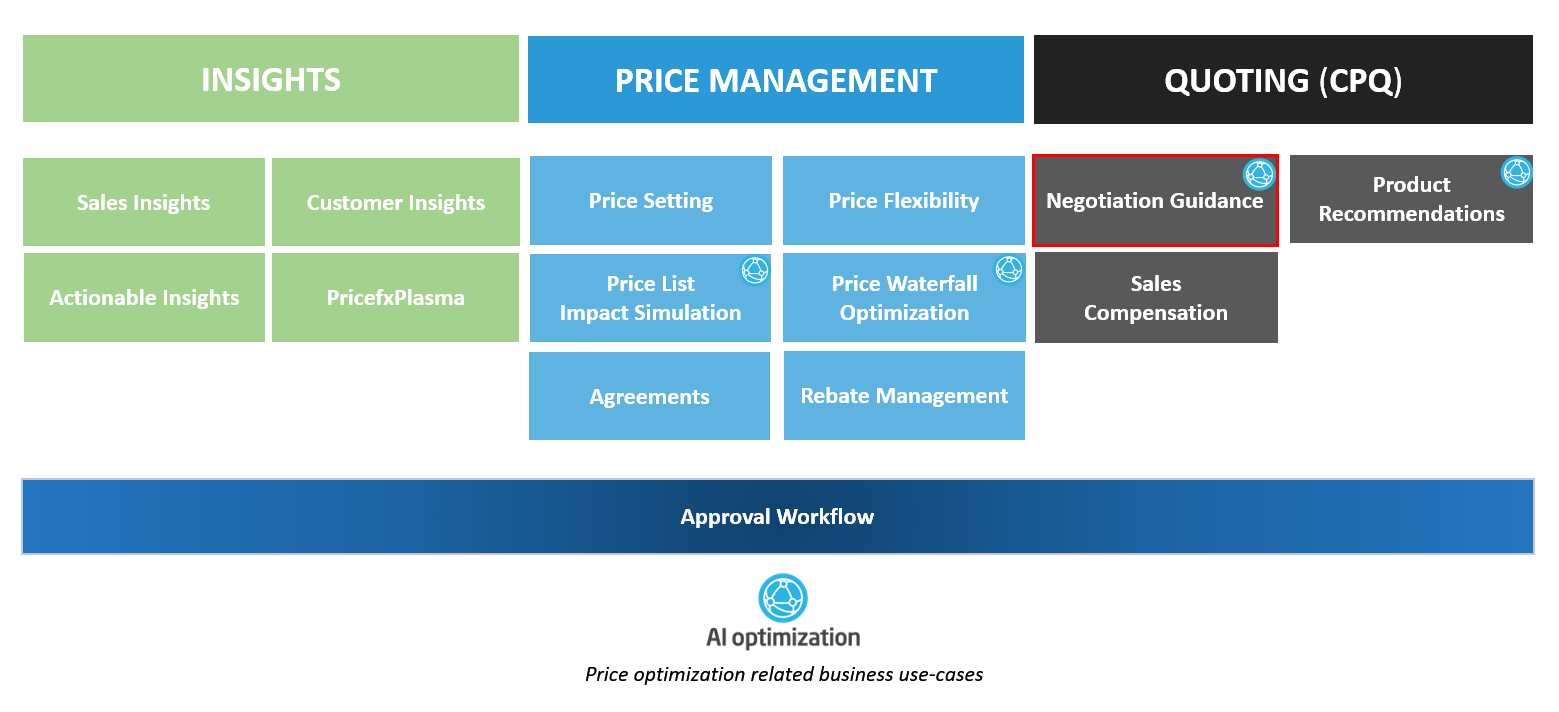
The idea behind the Negotiation Guidance model is very intuitive. When facing a new pricing event, you need to make a pricing decision. A sensible way to make this decision is to compare the situation with a similar one from the past. If you have sold the same product to the same customer before, you already have a good indication to start with. Or maybe you have never sold that product to the same customer before so you have nothing to compare to. In these cases, you would also want to check if you sold a similar product to that customer, or to a similar customer and consider that pricing too. That is where segmentation takes place because it provides a richer comparison set than if we were just looking for the exact same situation in the past. It allows us to explore more possibilities, align with your pricing strategy and avoid sticking with the same (possibly not ideal) pricing that was used in the past.
Pricefx Key Accelerators
To get started, you can also watch a video introducing Negotiation Guidance and its benefits.
Pricefx Solution
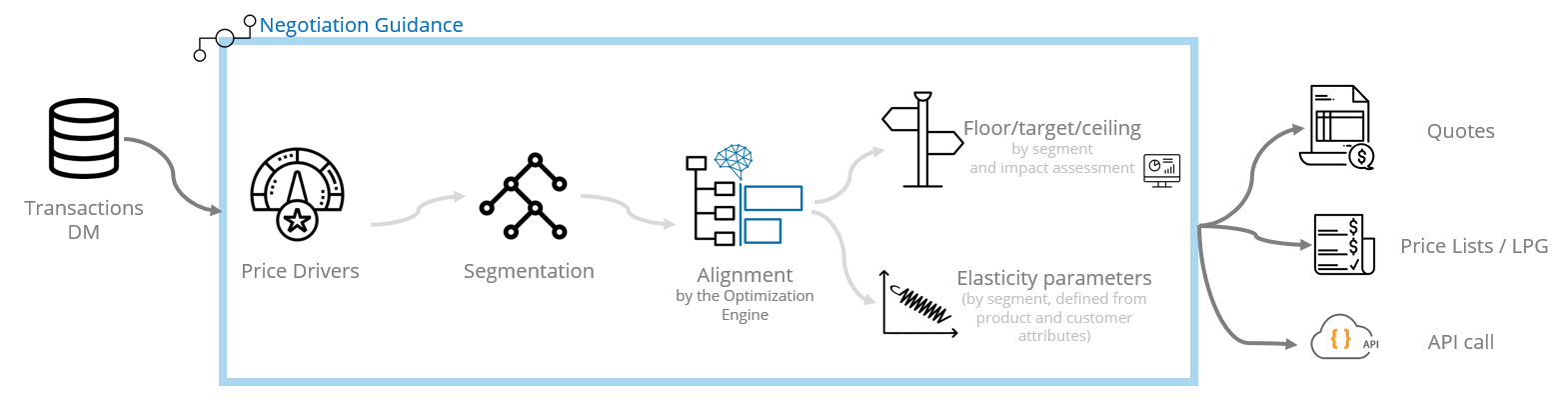
In our Negotiation Guidance model, first we provide some analysis and guidelines on the key attributes that drive the prices which we call Price Drivers. That way you can better understand if geography, product types or customer segments have a impact on the prices paid. Moreover, knowing the Price Drivers enables us to recommend segmentation levels. Of course, you can always select the segmentation level you wish to use.
Then, a segmentation tree is built and provides price recommendations and elasticity based on the information from each segment. The segmentation levels are usually a combination of product attributes, customer attributes, and even any selected transaction attributes.
The fact that we build a segmentation tree instead of considering all the combinations of attributes is crucial. We only go into such depth where there are enough transactions to make an informed decision and also we do not have to consider lots of irrelevant attribute combinations. Ideally, the segments should be consistent in the sense that most of the transactions within a segment should have similar pricing. Indicators are provided, so that you can make further analysis to understand consistency of segments.
The goal of our price optimization is then to assess the pricing potential of each segment and adjust subsequently. On top of that, alignments can be enforced in order to get consistency across segments based on your pricing strategy.
See also a video explaining how to optimize deals with Negotiation Guidance.
Approach
Negotiation Guidance relies on several steps:
-
Data analysis resulting in Price Drivers.
-
Building a segmentation tree.
-
Providing recommendations of floor, target, and ceiling as margin % or discount % depending on the selected optimization target.
-
Adjusting those recommendations by aligning segments based on pricing strategy. These recommendations are then ready to be used in other parts of the solution.
-
Each segment also comes with metrics, including elasticity parameters that can be leveraged for some other usage.
Optimization targets
5 optimization targets are supported for getting recommendations from Negotiation Guidance, here there are and how well suited to different use cases:
-
Discount rate, relying on a list price and differentiating prices through discounts. Well suited when the list prices are consistent for a large variety of use cases, from manufacturers to distributors. Business alignments will have the best consistency with this metric.
Additional use cases:-
Long‑term customer agreements where discounts are expressed versus a central list price and need consistent guardrails by customer tier / region.
-
Channel / reseller programs where partners get differentiated discounts but list prices stay common across channels.
-
-
Margin rate for a cost-plus approach, default approach for most distributors and manufacturers when costs are the main drivers. Might be sensitive to different cost levels.
Additional use cases:-
Quote guidance for project business (industrial equipment, building materials) where cost structures vary by project and margin % is the key control metric.
-
New product introductions where cost is known, list price is not yet stable, and you want to anchor decisions on target margin % per product family.
-
SPA / rebate negotiations where you want to ensure post‑rebate margins stay above a minimum per segment.
-
-
Margin per unit for a cost-plus approach when the reasoning is what is the added value on top of a raw cost that is mostly defined, sometimes at the industry level. Used mostly in Chemical and Packaging industry.
Additional use cases:-
Commodities / raw materials where price levels are largely market‑driven and steering focuses on absolute value per unit contribution.
-
High‑volume / low‑margin SKUs (e.g. fasteners, basic spare parts) where ensuring a minimum absolute unit margin is more meaningful than a percentage.
-
Tolling / contract manufacturing where the commercial logic is “processing fee per unit” on top of pass‑through cost.
-
-
Price Index, using a ratio between the price and a reference, typically the average price of the product. Price Index is a robust metric that can be used with no or poor costs and list prices. It is well-suited to differentiate prices across customers and market conditions.
Additional use cases:-
Markets with volatile costs or inconsistent costing where you can’t trust cost but still want relative positioning by segment.
-
Cross‑country or cross‑channel alignment, e.g. ensuring that a country/channel stay at a higher price index.
-
Reference‑based pricing where you want to align similar product lines (good/better/best) around a coherent price ladder without relying on a formal list price.
-
-
Unit Price: using directly the price per unit as the target. Only relevant when recommendations are done at the product level (product is one of the first segmentation level). Use cases: low number of products and prices differentiated only for customers attributes, but not for product attributes.
Additional use cases:-
Service pricing (hourly/day rates, maintenance fees) where the natural target is a direct price per unit of service.
-
To be used those metrics should already be present and computed in the data source, that’s a prerequisite.
Outputs
The outputs of Negotiation Guidance consist of recommendations of floor, target, and ceiling for either the discount rate or the margin rate or unit margin. Meaning for each segment, defined by a set of attributes and built within the segmentation tree, Negotiation Guidance recommends guardrails: floor, target, and ceiling for discount rate or margin rate or unit magin (depending on chosen optimization target). Those values are intended to be used later in the process to compute prices from either list prices for discount or costs for margin rate / unit margin. That process comes with the benefit of aggregating the recommendations at a segment level and using the recommendations dynamically following potential changes in list prices or costs.
Each segment also comes with elasticity parameters that are computed with segment scope and can also be leveraged for some other usage by other modules or models.
Limitations
-
Attributes/features – Negotiation Guidance relies on having the right features that impact the price/margin rate or discount rate or unit margin. If those features are not available or the data are incomplete, output quality will be low.
-
Business alignments are computed based on price gaps that rely on costs (for margin%) or list prices (for discount%), so if those are not consistent, those inconsistencies will be propagated. So it is better to use discount% as an optimization target, as list prices tend to be more consistent and less volatile over time.
For now, business alignments cannot be used if a “weight” is defined. -
Model outputs and recommendations – Negotiation Guidance is intended to provide recommendations by segment and not at a product and customer level (but most probably at a higher level of granularity). The recommendations will not directly include recommended prices for a specific product and customer. In case a maximum price change is required, this should be enforced later in the process, for example in the quote logic.
-
No predefined extension point – There is no out-of-the-box extension point defined for now. If you intend to add specific features, custom code should be written. (But then the accelerator becomes specific and it cannot be updated without extra effort to port those modifications.) Do not hesitate to report specific requirements and possible extension points to Pricefx.
-
Standard Model Evaluation might be slow to fetch recommendations, please use batch evaluation if multiple recommendations are requested as the same time, like in quotes.
-
Data requirements – See Data Requirements (Optimization - Negotiation Guidance).