
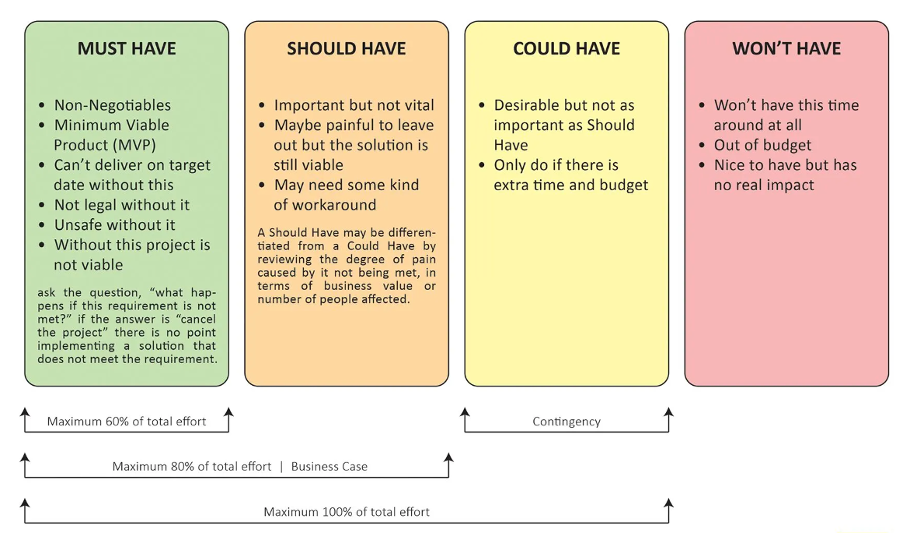
60/20/20 %
But it is always good to consider putting in buffers.
To avoid losing some of Could-Have(s) & to manage expectations.
What does MoSCoW mean?
The MoSCoW prioritization method is a widely-used framework for setting priorities and managing trade-offs during product development. The acronym MoSCoW stands for “must-have,” “should-have,” “could-have,” and “won’t-have (this time).” The method is a helpful tool for organizations that need to prioritize product features. It can be used in different situations and can help to resolve conflicts between stakeholders.
Must have
Requirements labelled as Must have are critical to the current delivery timebox in order for it to be a success. If even one Must have requirement is not included, the project delivery should be considered a failure (note: requirements can be downgraded from Must have, by agreement with all relevant stakeholders; for example, when new requirements are deemed more important). MUST can also be considered an acronym for the Minimum Usable Subset.
Should have
Requirements labelled as Should have are important but not necessary for delivery in the current delivery timebox. While Should have requirements can be as important as Must have, they are often not as time-critical or there may be another way to satisfy the requirement so that it can be held back until a future delivery timebox.
Could have
Requirements labelled as Could have are desirable but not necessary and could improve the user experience or customer satisfaction for a little development cost. These will typically be included if time and resources permit.
Won't have (this time)
Requirements labelled as Won't have, have been agreed by stakeholders as the least-critical, lowest-payback items, or not appropriate at that time. As a result, Won't have requirements are not planned into the schedule for the next delivery timebox. Won't have requirements are either dropped or reconsidered for inclusion in a later timebox.
How is a MoSCoW analysis conducted?
The method involves four steps. First, all the potential features are listed. Second, the features are evaluated according to three criteria: how much users will want the feature, how difficult it will be to implement, and how much the feature will improve the product. Third, the features are plotted on a graph according to these criteria. Finally, the features are prioritized based on where they fall on the graph.
Getting priorities straight
The MoSCoW prioritization method can be adapted to different situations and organizations, making it a versatile tool for decision-making. The advantages of using this method are that it’s simple to use, it can help spark discussions between team members, and it gets stakeholders on the same page. It offers a range of prioritization matrices to help you hierarchically structure task importance and get work done in the most optimal way.
Other methods used for product prioritization include:
RICE scoring model
PriX method prioritization method
Story mapping prioritization method
Value vs. effort prioritization method
Kano model prioritization method
Opportunity scoring prioritization method
The product tree prioritization method
Cost of delay prioritization method
Buy a feature prioritization method